


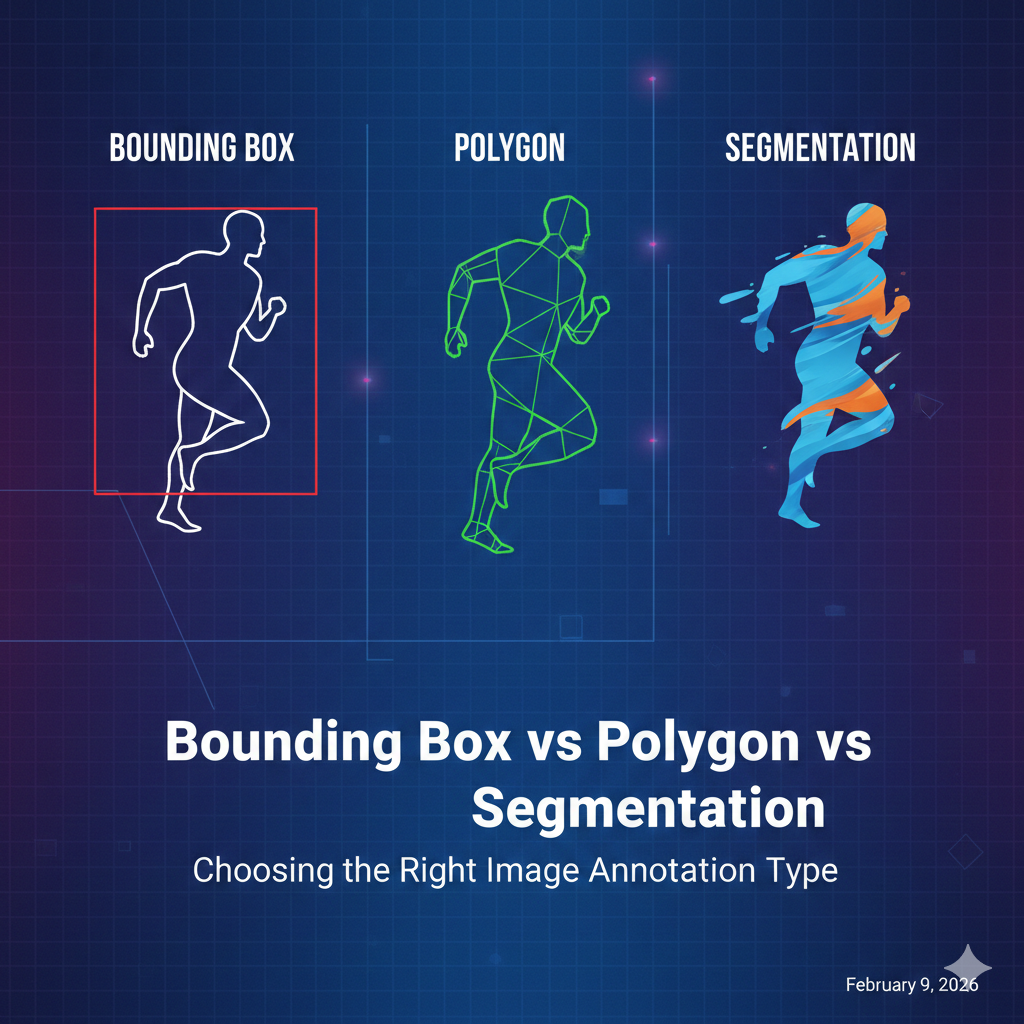
Computer vision performance is directly constrained by annotation fidelity. The geometry used to represent objects in training data determines how a model interprets spatial boundaries, object interactions, and environmental context. At Annotera, selecting the correct annotation primitive is treated as a modeling decision, not merely a labeling task. For organizations evaluating data annotation outsourcing or partnering with an image annotation company, understanding the trade-offs between bounding boxes, polygons, and segmentation masks is essential for cost control and model accuracy.
1. Bounding Box Annotation -
A bounding box is an axis-aligned rectangle defined by minimum and maximum x–y coordinates enclosing an object.
Strengths
Computational Efficiency
Bounding boxes minimize annotation entropy. Labeling speed is high, making them ideal for large-scale data annotation outsourcing projects where throughput is critical.
Model Compatibility
They align directly with object detection architectures such as YOLO, SSD, and Faster R-CNN, which regress rectangular proposals.
Lower Cost per Instance
Because annotators draw four points rather than complex contours, bounding boxes provide the lowest cost-to-coverage ratio.
Limitations
Background Noise Inclusion
Boxes inevitably contain non-object pixels. For irregular shapes (trees, pedestrians, animals), excess background introduces localization noise.
Poor Fit for Occlusions
Overlapping objects cannot be precisely separated, which degrades detection accuracy in dense scenes.
Limited Use in Pixel-Level Tasks
They are insufficient for tasks requiring shape precision such as medical imaging, lane detection, or fine-grained robotics perception.
Best Use Cases
-
Autonomous vehicle object detection (cars, traffic signs)
-
Retail shelf analytics
-
Basic surveillance monitoring
-
Early-stage model prototyping
Bounding boxes are the default entry point for organizations engaging a data annotation company for detection-first pipelines.
2. Polygon Annotation :
Polygon annotation outlines an object with multiple connected vertices, closely matching its contour.
Strengths
Shape Precision
Polygons significantly reduce background inclusion, improving Intersection over Union (IoU) metrics.
Efficient Compromise
They provide near-segmentation accuracy at lower cost than full pixel masks, which is valuable in image annotation outsourcing where frame volume is high.
Better Occlusion Handling
Complex shapes can be individually delineated even in crowded environments.
Limitations
Higher Annotation Time
More vertices increase labeling effort and quality control overhead.
Human Variability
Contour decisions may differ among annotators, requiring stricter guidelines and QA pipelines.
Not Pixel-Perfect
Edges are approximations; ultra-fine boundaries (hair strands, thin wires) remain imperfect.
Best Use Cases
-
Drone imagery analysis
-
Agriculture (crop boundary detection)
-
Construction site monitoring
-
Retail planogram compliance
Polygons are often recommended when working with a image annotation company to maintain spatial consistency across frames without incurring segmentation-level costs.
3. Segmentation (Pixel-Level Masking)
Segmentation assigns a class label to every pixel (semantic) or each object instance (instance segmentation).
Strengths
Maximum Spatial Fidelity
Masks capture exact object boundaries, enabling precise scene understanding.
Essential for High-Risk AI
Medical diagnostics, surgical robotics, and autonomous navigation rely on segmentation for safety-critical perception.
Supports Advanced Tasks
Scene parsing, depth estimation, and AR/VR rendering depend on pixel-level detail.
Limitations
Highest Cost and Time
Masking requires meticulous tracing. QA complexity scales with pixel granularity.
Data Volume Burden
Large segmentation datasets demand more storage and processing.
Tooling Requirements
Advanced annotation tools with AI-assisted pre-labeling are necessary to maintain productivity.
Best Use Cases
-
Medical imaging
-
Autonomous driving lane detection
-
Satellite imagery analysis
-
Industrial defect inspection
Segmentation is typically deployed in mature AI programs where performance gains justify investment in specialized data annotation company workflows.
4. Comparative Analysis
| Factor | Bounding Box | Polygon | Segmentation |
|---|---|---|---|
| Annotation Speed | Fastest | Moderate | Slowest |
| Cost per Object | Low | Medium | High |
| Boundary Precision | Low | High | Very High |
| Background Noise | High | Low | None |
| Model Complexity Supported | Basic detection | Detection + tracking | Full scene understanding |
| Ideal Project Stage | Prototype | Scaling | Optimization |

 English
 Arabic
 French
 Portuguese
 Deutsch
 Turkish
 Dutch
Dutch
 Italiano
 Russian
 Romaian
 Portuguese (Brazil)
 Greek
Greek