


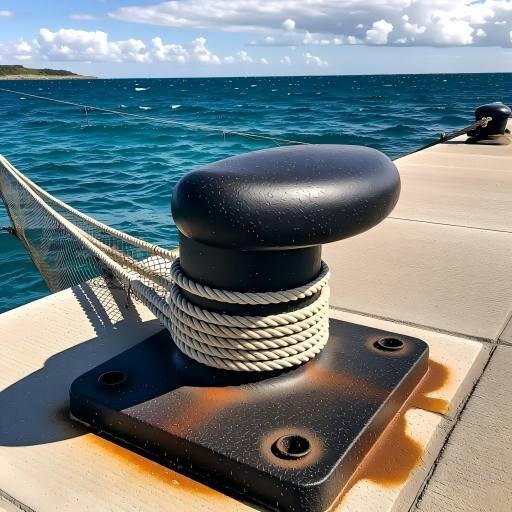
The concept of a bollard dates back centuries: what began as simple wooden posts or shore-side posts to tie up small boats has evolved into the sophisticated marine hardware we rely on today. In maritime contexts, a bollard refers to a sturdy post — either on a vessel’s deck or on quays — to secure mooring lines.
Historically, early bollards could even be repurposed items — for example, old cannons set upright were once used as mooring bollards. Over time, as ships grew larger and maritime trade intensified, the demands on mooring systems increased dramatically. A simple wooden post would no longer suffice. Thus emerged a variety of ship mooring bollards made from robust materials like cast iron, ductile iron, or welded steel, designed to endure tremendous static and dynamic loads.
Technically, a marine bollard consists of several components: the main body (the vertical post), a base plate (bolted or welded to dock or deck), horns or studs for attaching mooring lines, and sometimes lifting lugs, protective caps, and load rating plates. The body must be dimensioned and reinforced to resist not only the static pull of mooring lines, but also dynamic forces caused by tides, waves, or wind.
The design has also diversified: depending on the size of the vessel, mooring line configuration, and environmental conditions, different types of bollards are used — single, double-bitt, T-head, kidney-shaped, pillar, camberhead, among others. For example, T-head or double-bitt bollards allow multiple lines to be secured; kidney-shaped and camberhead designs help reduce line chafing and distribute pressure more evenly.
Furthermore, modern standards and regulations guide the manufacturing, installation, and maintenance of mooring bollards. As vessel sizes increase — including tankers, container ships, cruise ships — ports and shipyards must upgrade to high-capacity bollards, taking into account foundation strength, load distribution, environmental factors, and safety margins.
In conclusion, the journey from rudimentary mooring posts to modern ship mooring bollards reflects the evolution of maritime technology, vessel design, and port infrastructure requirements. The marine bollard remains a cornerstone of safe docking — a subtle but powerful enabler of global sea transportation.

 English
 French
 Spanish
 Portuguese
 Deutsch
 Turkish
 Dutch
Dutch
 Italiano
 Russian
 Romaian
 Portuguese (Brazil)
 Greek
Greek