


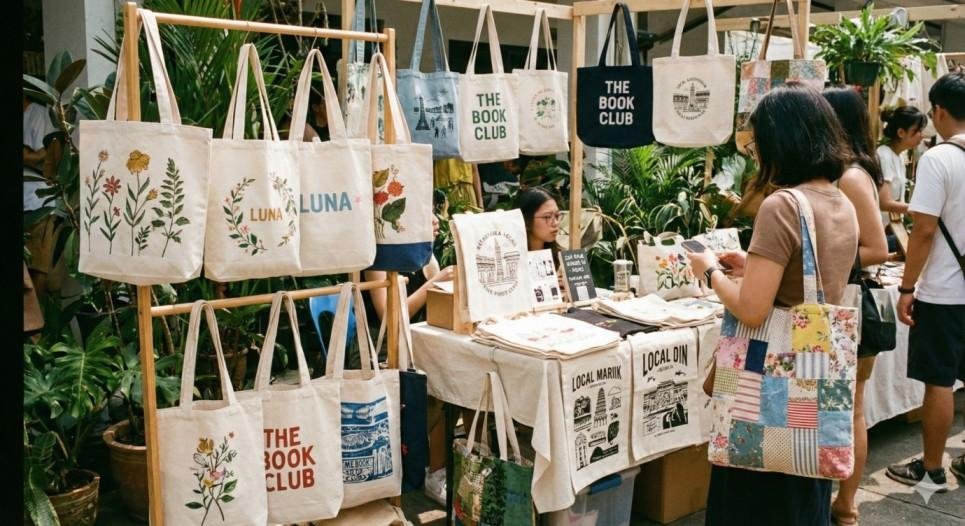
For years, the fashion world held us captive in the grip of the "Clean Girl" aesthetic. Everything had to be beige, pristine, and perfectly organized. Our bags were structured, our lives were seemingly curated, and there was no room for the beautiful, chaotic mess of actual living. But if you have walked down a city street or scrolled through your social feeds lately, you might have noticed a refreshing shift. The era of the sterile accessory is ending, and in its place, a new hero has emerged. It is slouchy, it is overflowing, and it is undeniably yours. We are witnessing the rise of the "Life-Logging Tote."
This isn’t just about carrying things from point A to point B anymore. It is about the bag serving as a physical scrapbook of your daily existence. We are seeing tote bags that are scribbled on, patched up, covered in charms, and heavy with the weight of a well-lived life. It is a rebellion against the idea that we need to be polished to be stylish. People are no longer afraid to let their bag show wear and tear; in fact, they are encouraging it. The scuffs and the stains are no longer flaws; they are chapters in a story.
At the heart of this movement is a return to tactile creativity. We aren’t just buying bags; we are altering them. There is a massive surge in people seeking out custom embroidery tote bags to create a base layer for this self-expression. Whether it is a line of poetry stitched into the handle, a floral motif covering a coffee stain, or a complex design that represents a personal milestone, embroidery has transformed the humble canvas tote into a piece of mobile art. It is the antithesis of the mass-produced luxury logo. Instead of advertising a brand, you are advertising your own identity.
The Jane Birkin Effect
To understand this new trend, we have to look back at an unlikely muse: Jane Birkin. While she is the namesake of the world's most expensive handbag, she was famous for treating her own luxury bags like utility baskets. She didn't keep them in dust bags or handle them with white gloves. She stuffed them to the brim, adorned them with stickers, tied beads to the handles, and let them get scratched. She understood something that modern fashion often forgets: an object only becomes truly luxurious when it is useful.
Today, Gen Z and Millennials are channeling this energy into the canvas tote. It is being called "Birkin-fying" your bag, but you don't need a five-figure budget to participate. You just need a sturdy canvas bag and the willingness to accessorize without restraint. We are seeing heavy keychains, ribbons, rosary beads, and safety pins utilized to create a chaotic, jingling, joyful noise whenever the wearer walks.
This trend is psychologically significant. In a digital world where everything is stored in the cloud, we are craving physical totems. We want to carry our world with us. The maximalist tote allows us to have our book, our water bottle, our gym clothes, our laptop, and three different lip glosses, all while displaying a collection of enamel pins we picked up on a road trip three years ago. It is permission to take up space and be unprepared for nothing.
The Canvas as a Diary
What separates the current tote bag craze from trends of the past is the level of permanence involved in the customization. In the past, you might have tied a scarf around a handle. Now, people are altering the fabric itself. This is where the artistry comes in.
"The tote bag is the democratic canvas of the 21st century. It is accessible, durable, and begs to be drawn on."
Social media platforms are flooded with tutorials on how to paint, dye, and stitch canvas. We are seeing a revival of visible mending—a Japanese technique known as Sashiko—where tears in the fabric are repaired with contrasting thread to highlight the history of the item rather than hide it. If your favorite tote gets a hole in the bottom from carrying too many library books, you don't throw it away. You patch it with a piece of denim or embroider a star over the gap.
This shifts the consumer mindset from "buying" to "building." When you invest hours into embroidering a design onto your bag, you form an attachment to it that fast fashion can never replicate. That bag becomes a part of you. You are less likely to discard it because it is no longer a disposable commodity; it is a repository of your time and creativity.
Functionality Meets the "Anti-It" Bag
For a long time, the "It Bag" was a status symbol defined by exclusivity and price. The new "Anti-It" bag is defined by utility and approachability. There is a certain coolness in the lack of pretension. Carrying a tote bag suggests you have things to do. It implies a life of action—going to the market, heading to a pottery class, commuting to a co-working space.
This shift has also blurred the lines of appropriateness. A few years ago, bringing a canvas tote to a nice dinner or a corporate meeting might have been seen as sloppy. Now, it is a style choice. It signals confidence. It says, "I prioritize substance over structure."
However, this doesn't mean the bags are low quality. The best "messy" totes start with a foundation of incredible durability. To survive the pins, the stitching, and the heavy loads, the canvas needs to be heavyweight and the construction needs to be reinforced. The irony of the "beat-up bag" look is that you actually need a higher quality product to pull it off. A thin, cheap promotional bag will shred under the weight of this trend. The base must be solid for the art to survive.
The Sustainability Angle
We cannot discuss the resurgence of the tote without addressing the elephant in the room: sustainability. For years, we were told that buying a cotton tote was the eco-friendly alternative to plastic bags. Then, studies came out showing that you would need to use a cotton tote thousands of times to offset the water used to produce it. This led to "tote bag fatigue," where people had closets full of freebie bags they never used.
The personalization trend is actually the solution to this problem. When we customize a bag, we are committing to using it for the long haul. We are selecting one bag to be our daily driver rather than mindlessly accepting twenty free ones.
By turning a single tote into a piece of art, we are extending its lifecycle significantly. We are washing it, repairing it, and evolving it. A bag that you have embroidered with your pet’s face or your favorite song lyrics is not ending up in a landfill next year. This is "slow fashion" in its truest form—taking a simple object and infusing it with enough value that it stays in circulation for decades.
Corporate Gifting Gets a Soul
Interestingly, this trend towards hyper-personalization is rippling upwards into how companies and communities approach merchandise. The era of the cheap, throwaway conference bag is dying. Brands are realizing that if they want their logo to be carried, the bag itself has to be desirable. They are moving away from slapping a giant logo in the center and moving towards subtle branding that leaves room for the user to make it their own.
Businesses are beginning to understand that the bag is a collaboration between the brand and the user. The most successful branded totes right now are the ones that provide high-quality blank space. They are heavy-duty, neutral, and aesthetically pleasing enough that the recipient actually wants to add their own flair to it.
This is where the supply chain becomes critical for creators and businesses alike. Whether you are an artist planning to launch a line of hand-painted bags, or a company looking to create a "forever bag" for your employees, the raw material matters more than ever. You need a consistent, durable canvas that takes ink and thread well. Sourcing high quality custom tote bags bulk allows creators to maintain that standard of excellence while keeping costs manageable. It ensures that the "canvas" you are providing—whether for a painting project or a corporate gift—is worthy of the art that will eventually cover it.
The Future is Personal
The tote bag is no longer just a bag. It is a mirror. It reflects our move away from polished perfectionism toward messy, authentic reality. It reflects a desire to make things with our hands and to keep the things we own for longer.
So, dig that plain canvas bag out of your closet. Find some safety pins, some fabric markers, or a needle and thread. Don't worry about ruining it—that is impossible. The only way to ruin a tote bag in 2025 is to leave it blank. Fill it up, wear it out, and let it tell your story.

 English
 Arabic
 French
 Spanish
 Portuguese
 Deutsch
 Turkish
 Dutch
Dutch
 Russian
 Romaian
 Portuguese (Brazil)
 Greek
Greek