



Overview of the Allen-Bradley 1766-L32BXB
The Allen-Bradley 1766-L32BXB is a part of the MicroLogix 1400 series — a compact PLC family known for its robust networking capabilities and cost-effective design. This model’s triple-port architecture allows simultaneous Ethernet and serial communications, enabling integration with a diverse range of industrial equipment.
Unlike older PLCs that required expansion modules for Ethernet or Modbus connectivity, the 1766-L32BXB includes these ports natively, making it ideal for:
- Retrofitting older machines with minimal downtime.
- Building cost-efficient automation systems with multi-protocol requirements.
- Connecting both modern and legacy equipment without additional hardware.
Combo RS-232/RS-485 Port (Channel 0)
2.1 Hardware Description
This multi-function serial port, located on the front panel, is configurable as either RS-232 or RS-485 through software settings in RSLogix 500 or Connected Components Workbench. It uses a standard 9-pin D-sub connector.
2.2 Supported Protocols
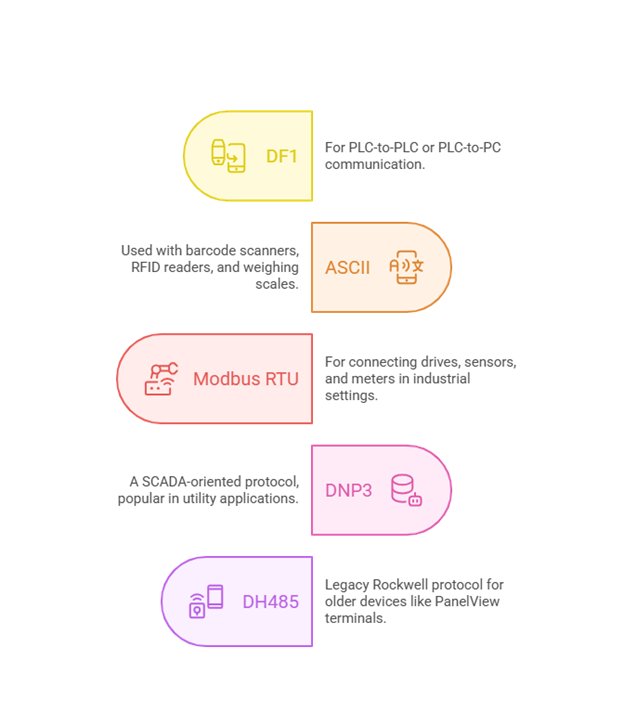
2.3 Industrial Applications
- Multi-drop Modbus RTU networks for drive control.
- Connecting to older PanelView HMIs without protocol converters.
- Integrating legacy controllers into modern automation setups.
Ethernet Port
3.1 Hardware and Speed
The Ethernet interface uses an RJ45 connector and supports 10/100 Mbps transmission with auto-negotiation. It works with both static and dynamic IP addressing.
3.2 Supported Protocols
- EtherNet/IP – For Rockwell Automation devices and distributed I/O.
- Modbus TCP/IP – Enables interoperability with non-Rockwell equipment.
- DNP3 over TCP/IP – Ideal for utility and infrastructure SCADA systems.
3.3 Special Features
- Built-in Web Server – Provides real-time monitoring without specialized software.
- Email Alerts – Sends automatic messages based on programmed triggers.
- Remote Access – Allows off-site configuration and troubleshooting.
3.4 Industrial Applications
- SCADA data acquisition and control.
- Connecting HMIs directly over Ethernet.
- Remote system diagnostics via VPN.
Non-Isolated RS-232 Port (Channel 1)
4.1 Hardware Description
This secondary serial port is non-isolated, making it suitable for direct local connections where electrical isolation isn’t necessary.
4.2 Supported Protocols
Same as Channel 0: DF1, ASCII, Modbus RTU, DNP3, DH485.
4.3 Industrial Applications
- Local programming and troubleshooting with a laptop.
- Dedicated connection to a serial-based HMI.
- Serving as a second serial link in advanced control architectures.
Comparing the Three Ports
| Feature | Combo RS-232/RS-485 (Ch0) | Ethernet | RS-232 Non-Isolated (Ch1) |
| Protocol Support | DF1, ASCII, Modbus RTU, DNP3, DH485 | EtherNet/IP, Modbus TCP/IP, DNP3 | DF1, ASCII, Modbus RTU, DNP3, DH485 |
| Speed | Up to 115.2 kbps | 10/100 Mbps | Up to 115.2 kbps |
| Isolation | Yes (RS-485 mode) | Yes | No |
| Typical Usage | Multi-drop serial networks, Modbus RTU | SCADA integration, HMI, remote access | Programming, local HMIs |
Key takeaway: Ethernet provides the highest speed and best suited for high-bandwidth, real-time data exchange, while the serial ports are ideal for lower-speed, point-to-point, or multi-drop industrial communication.
Best Practices for Using Communication Ports
- Segregate Traffic – Avoid routing multiple high-speed devices through the same port, especially on serial channels, to prevent communication delays.
- Use Ethernet for High Data Volume – Reserve RS-232/RS-485 for low-bandwidth or legacy devices.
- Enable Security – Apply passwords, disable unused protocols, and use VPN tunnels for remote Ethernet access to protect against cyber threats.
- Label Connections – In multi-port installations, clear labeling of cables and ports helps prevent miswiring during maintenance.
- Test Configurations Offline – When setting up Modbus or DNP3 networks, perform initial configuration in a test environment to avoid disrupting production systems.
Real-World Example
Scenario:
A water treatment facility implements the 1766-L32BXB to connect and monitor equipment across the plant:
- Ethernet Port: Linked to the SCADA system over EtherNet/IP, enabling real-time monitoring and remote control.
- RS-232/RS-485 Port (Ch0): Running Modbus RTU to communicate with multiple flow meters installed in various stages of the treatment process.
- Non-Isolated RS-232 Port (Ch1): Connected to a local HMI panel for operator control and status display.
Outcome: This triple-port configuration eliminates the need for extra communication modules, reduces network bottlenecks, and ensures all systems run simultaneously without interfering with one another.
Conclusion
The Allen-Bradley 1766-L32BXB is one of the most communication-flexible PLCs in the MicroLogix 1400 family. Its combination of Ethernet, RS-232/RS-485, and non-isolated RS-232 ports enables it to bridge modern industrial Ethernet networks with legacy serial devices.
For system integrators and automation engineers, this means:
- Faster deployment without extra modules.
- Smooth integration between old and new technologies.
- Reliable, simultaneous operation across multiple protocols.
Whether in water treatment, manufacturing, or infrastructure automation, the 1766-L32BXB remains a go-to choice for hybrid industrial systems where diverse communication needs are the norm.

 Arabic
 French
 Spanish
 Portuguese
 Deutsch
 Turkish
 Dutch
Dutch
 Italiano
 Russian
 Romaian
 Portuguese (Brazil)
 Greek
Greek