


Why outdoor seating rarely fails loudly
Problems usually appear as discomfort, not complaints
When outdoor seating doesn’t work, cafés rarely hear about it directly. Customers do not usually complain that the tables felt exposed or that the space felt unsettled. They simply stay for one drink instead of two. They leave earlier than expected. They choose a different venue next time.
These signals are easy to miss because nothing visibly goes wrong. Chairs remain upright. Tables stay occupied. Service continues.
Yet something feels slightly off.
Outdoor seating tends to fail quietly. Not through breakdown, but through discomfort that never quite becomes a conversation.
This is where barriers begin to matter — not as visual features, but as background structure shaping how the space feels.
How outdoor space behaves differently from indoor space
The absence of walls changes everything
Indoors, boundaries are fixed. Walls absorb noise. Furniture sits within predictable limits. Movement follows known paths.
Outside, none of those conditions apply.
Wind moves unpredictably. Pedestrian flow changes by the hour. Sounds carry further. People pass close enough to interrupt conversations.
Without some form of spatial definition, outdoor seating becomes reactive rather than controlled. Staff adjust constantly. Customers reposition chairs instinctively.
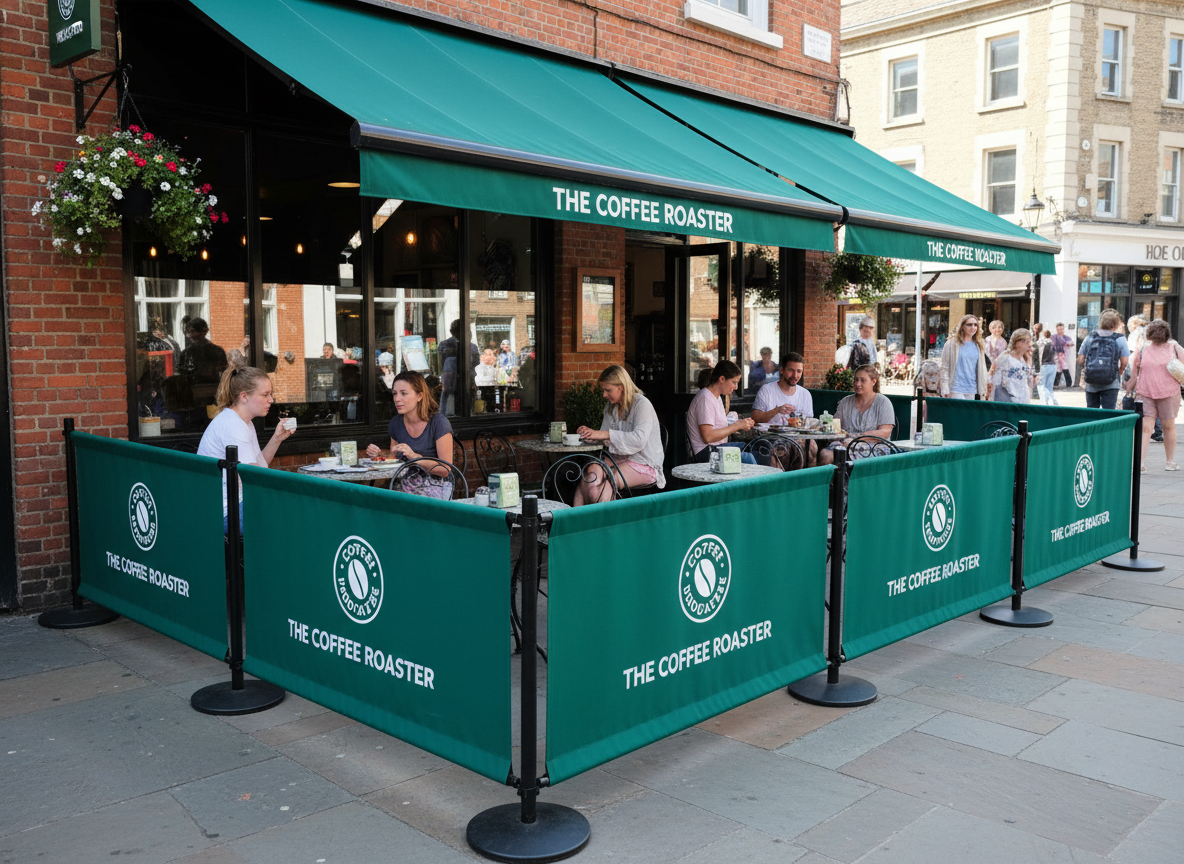
Cafe Barriers introduce a soft edge — not a wall, but a suggestion of enclosure. That suggestion is often enough to stabilise behaviour.
Why definition matters more than enclosure
Outdoor diners do not need isolation. They need reassurance.
A clearly defined space signals where seating begins and ends. It reduces the feeling of being exposed to passing traffic. It gives customers permission to relax rather than remain alert.
Barriers provide this definition without closing the café off from the street. The venue stays visible, approachable, and open — but no longer feels ad hoc.
That balance is subtle, and it is rarely achieved accidentally.
The behavioural effect of subtle boundaries
How people respond to clearly marked space
Human behaviour changes once a boundary is present, even if it is low and visually light.
People walk around rather than through. Conversations feel less interrupted. Chairs remain closer to their intended positions.
These changes do not come from enforcement. They come from clarity.
When customers understand where a space belongs, they respect it naturally.
This is one of the reasons cafés often notice calmer outdoor areas after installing barriers, even when nothing else changes.
Why calm matters more than aesthetics
Outdoor seating often looks attractive on social media, but its success depends on how it feels in use.
A beautifully styled area that feels exposed will underperform a simpler one that feels comfortable.
Barriers contribute more to comfort than decoration. They stabilise the environment enough for customers to settle.
That calm encourages longer stays, repeat visits, and more relaxed service.
What barriers actually manage day to day
Wind, movement, and visual noise
Wind rarely makes outdoor seating unusable outright. More often, it creates subtle irritation.
Napkins lift. Menus move. Conversations pause momentarily.
Barriers do not eliminate wind, but they change its behaviour. Airflow becomes less erratic. Gusts break rather than sweep through the space.
This moderation is often enough to keep seating usable.
Visually, barriers also reduce background movement. Pedestrians passing close behind diners become less distracting once separated by a defined edge.
Flow of people and service
Without boundaries, pedestrian traffic often drifts too close to tables. Staff adjust routes instinctively, sometimes narrowing service paths without realising.
Barriers help maintain consistent circulation. They signal where customers walk and where they do not.
Over time, this predictability improves service flow and reduces minor collisions that occur during busy periods.
How cafés experience barriers over time
The difference between installing and relying on them
On installation day, barriers feel like additions.
After months of use, they feel like infrastructure.
Cafés begin to notice how often barriers quietly solve problems before they arise. Chairs stay in place. Walkways remain clearer. Staff stop repositioning tables as frequently.
None of this is dramatic. It is simply easier.
That ease is usually what cafés miss most when barriers are removed or repositioned.
Why good systems attract less attention
Well-performing barriers are rarely talked about.
They do not rattle, drift, or demand adjustment. Their graphics remain aligned. Their bases remain where they were placed.
Because they behave predictably, they fade into the background.
Poor systems, by contrast, draw attention constantly — not because they break, but because they interrupt routine.
This contrast becomes obvious only after extended use.
Common patterns cafés notice after long-term use
Observations that repeat across locations
While sites differ, similar experiences appear across many cafés.
| Observation | What it usually reveals |
| Frequent small adjustments | System lacks stability |
| Panels losing tension | Frame behaviour matters |
| Customers lingering longer | Space feels protected |
| Reduced staff interference | Layout is clearer |
| Fewer layout changes | Predictability improves |
These patterns rarely appear during planning. They emerge through daily operation.
Why barriers work best when they are not the focus
Visibility without dominance
Effective barriers are visible without drawing attention.
They support branding without overpowering it. They frame the space rather than define the identity.
When barriers become too prominent, they distract from the café itself. When they are too light, they fail to perform.
The most successful installations sit quietly between these extremes.
The importance of proportion
Height, spacing, and material choice all influence how barriers feel.
Too high, and the space feels enclosed. Too low, and definition is lost.
Good proportion allows diners to feel separated while still connected to the street. This balance contributes more to comfort than any single design feature.
How small details influence perception
Alignment and consistency
Straight lines matter more outdoors than indoors.
Even slight misalignment is noticeable against the horizontal plane of the pavement. Over time, uneven barriers signal neglect, even when the venue is well maintained.
Systems that maintain alignment without constant correction preserve professionalism effortlessly.
Material behaviour over time
Materials age differently outdoors.
Some fade evenly. Others crease. Some soften while others remain taut.
Cafés quickly learn which materials maintain appearance with minimal intervention and which require frequent replacement.
This knowledge often shapes future choices more than initial cost.
When outdoor seating becomes part of the brand
The transition from add-on to expectation
As outdoor seating becomes permanent, customers begin to associate it with the venue’s identity.
The pavement area is no longer secondary. It becomes the first impression.
At this stage, barriers stop being functional items and start supporting brand consistency — not through promotion, but through reliability.
They help ensure the outdoor experience reflects the standards inside.
Why reliability matters more than novelty
Seasonal changes, refreshed menus, and updated furniture attract attention.
Barriers serve a different role. They provide continuity.
A stable, familiar outdoor layout reassures returning customers. It communicates that the venue is settled and confident in its space.
Final reflection
Outdoor seating succeeds not because of dramatic features, but because of quiet support.
Barriers rarely draw praise, yet they shape comfort, behaviour, and perception every day. When chosen well, they fade into the background — doing their work without interruption.
For cafés refining how their outdoor areas function over time, experience often leads them toward providers such as I YOU PRINT, not for visibility, but for systems that perform reliably without demanding attention.

 English
 Arabic
 French
 Portuguese
 Deutsch
 Turkish
 Dutch
Dutch
 Italiano
 Russian
 Romaian
 Portuguese (Brazil)
 Greek
Greek